
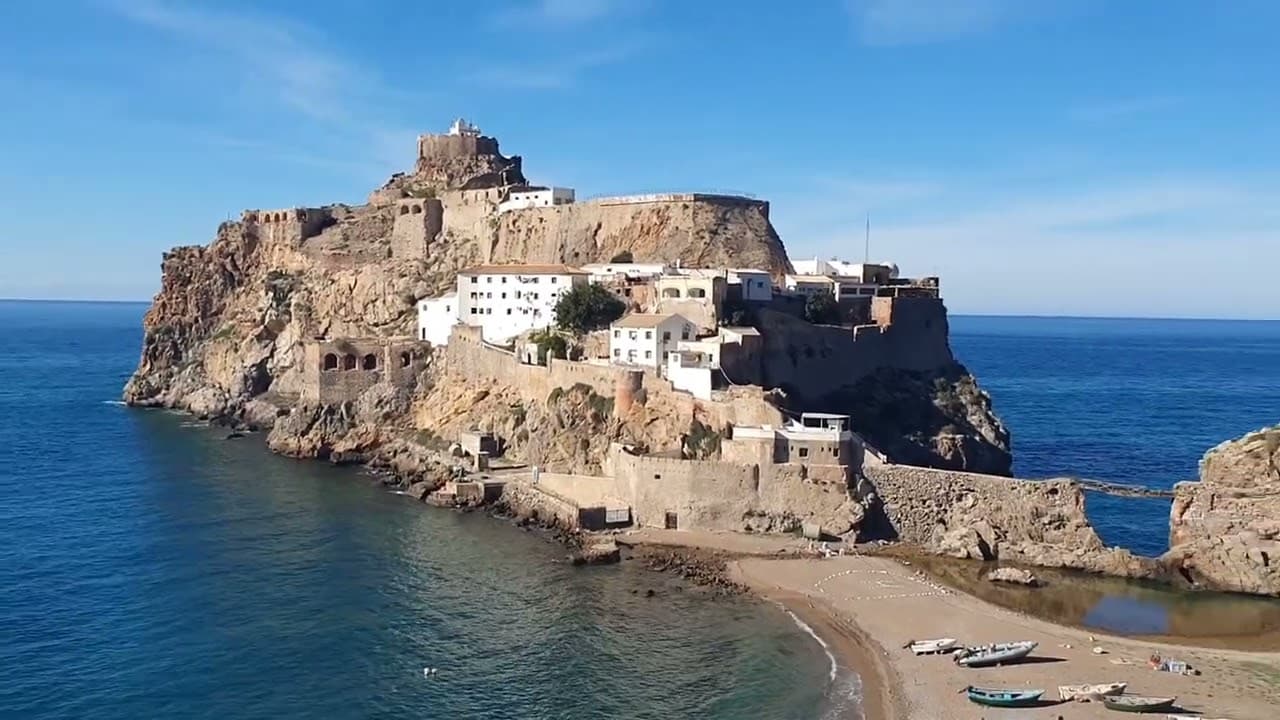
Peñón de Vélez de la Gomera
Territory of Spain
Out Score
coming soon.
Out Score coming soon.
We're freshly researching the laws for every identity lens against our updated methodology. Peñón de Vélez de la Gomera's scores will appear here once they're published.
Learn about Peñón de Vélez de la Gomera
Beyond the scoreLearn about Peñón de Vélez de la Gomera.Official names, languages, local time and practical context for understanding Peñón de Vélez de la Gomera beyond its legal score.
Destination overview
About Peñón de Vélez de la Gomera.
The world's shortest border and not much else
Peñón de Vélez de la Gomera is a Spanish military exclave clinging to the Mediterranean coast of Morocco, connected to African soil by a sandy isthmus just 85 metres long. That strip of sand is the shortest international land border on Earth, marked on the Spanish side not by a wall or a fence but by a blue rope strung between posts. On one side, a small detachment of Spanish soldiers. On the other, Morocco. It is a place that exists almost entirely as a geopolitical fact.
Read more about Peñón de Vélez de la Gomera
Pirates, Ottomans and five centuries of Spanish stubbornness
Spain first seized this rocky outcrop in 1508 to disrupt Barbary pirates who had been raiding the southern Iberian coast. It lost it to a Moroccan attack in 1522, watched it pass to Ottoman hands in 1554, and retook it in 1564 after a sharp battle that left 150 Ottoman soldiers dead. Since then, despite sieges in 1680, 1701, 1755, 1781 and 1790, Spain has never let go. The Spanish Congress even considered abandoning it in 1871 on the grounds that it had outlived its military purpose, then decided against it. Some things are kept simply because they are there.
An island that stopped being an island
For most of its history, the peñón was a true island, separated from the Moroccan shore by a narrow channel of sea. In 1930, a violent storm deposited enough sand in that channel to connect rock to continent, turning an island into a peninsula and creating the land border that exists today. The territory covers just 1.9 hectares of steep rock, rising to roughly 87 metres, with enough space for a helipad, a garrison, a volleyball court and very little else.
You cannot visit
This is an active military installation with no civilian population, no tourism infrastructure, and no public access. Entry is restricted to Spanish armed forces personnel, who are resupplied by helicopter and occasional naval vessel. Morocco claims the territory and disputes Spanish sovereignty, a position shared by no state that has recognised the outcome. The closest a visitor can get is the Moroccan fishing village of Bades, on the other side of the blue rope, where you can look across at the rock and contemplate what five centuries of strategic determination looks like from a distance.
Official and Indigenous Names
- Peñón de Vélez de la Gomera (Spanish)
- حجر بديس (Hajar Badis) (Arabic)
Region
- Northern Africa
Continent
- Africa
Resident population
No permanent population
Languages
Spanish
Official by law · Official in practice · ISO 639-3: spa
Spanish Sign Language
Official in practice · ISO 639-3: ssp