
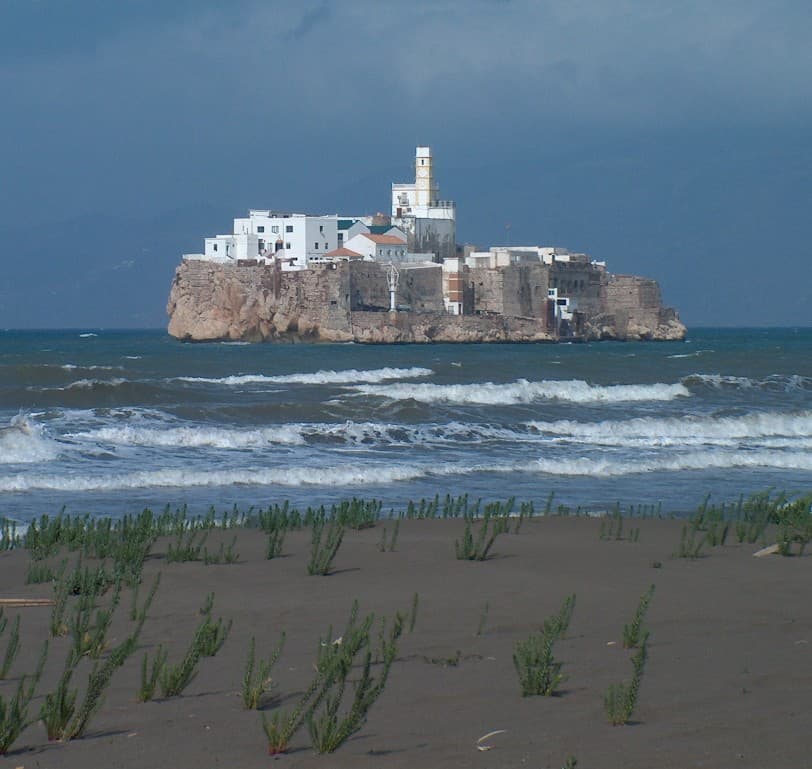
Peñón de Alhucemas
Territory of Spain
Out Score
coming soon.
Out Score coming soon.
We're freshly researching the laws for every identity lens against our updated methodology. Peñón de Alhucemas's scores will appear here once they're published.
Learn about Peñón de Alhucemas
Beyond the scoreLearn about Peñón de Alhucemas.Official names, languages, local time and practical context for understanding Peñón de Alhucemas beyond its legal score.
Destination overview
About Peñón de Alhucemas.
Three rocks, a fort and 300 metres of sea
Peñón de Alhucemas is the largest and most prominent of three small Spanish islets sitting just 300 metres off the Moroccan coast near Al Hoceima in the Bay of Alhucemas. The main rock measures 220 metres east to west and rises to 27 metres above sea level. It is entirely occupied by a fort, a handful of houses and a small church. Alongside it sit Isla de Tierra and Isla de Mar, two flat, uninhabited platforms of rock with a combined area less than a tennis court apiece. Together the three islets cover 4.6 hectares of Alboran Sea.
Read more about Peñón de Alhucemas
Ceded, garrisoned and never returned
The Saadi dynasty ceded these islands to Spain in 1559 in exchange for military assistance against Ottoman expansion along the Moroccan coast. Spain established a permanent garrison on Peñón de Alhucemas in 1673 and has maintained a presence ever since. The fort played a modest strategic role for two centuries until the garrison was quietly withdrawn in 1961, by which point the rock had outlived its original purpose. A small military contingent returned in later decades, and in 2012 it comprised an infantry section of 25 to 30 men from the 32nd Mixed Artillery Regiment, resupplied by sea.
A landing place written into Rif War history
The bay in front of these islands was the site of the 1925 Alhucemas landing, a joint Spanish and French amphibious operation against Berber forces during the Rif War that is considered one of the earliest successful amphibious assaults of the modern era. The rocky prominence of Peñón de Alhucemas provided cover and logistics for that operation, lending it a footnote in military history disproportionate to its size. Morocco has contested Spanish sovereignty over the islets since independence in 1956, as it does for all the plazas de soberanía.
Closed to the public, visible from the shore
There is no civilian access to any of these islands. No tourism, no accommodation, no way in. The nearest point of approach for a visitor is the Moroccan coastal town of Al Hoceima, which sits within sight of the rocks and has its own beaches, seafood and a relaxed Mediterranean character entirely independent of the Spanish military presence just offshore.
Official and Indigenous Names
- Peñón de Alhucemas (Spanish)
- حجرة النكور (Hajar al-Nkur) (Arabic)
Region
- Northern Africa
Continent
- Africa
Resident population
No permanent population
Languages
Spanish
Official by law · Official in practice · ISO 639-3: spa
Spanish Sign Language
Official in practice · ISO 639-3: ssp
Tarifit
Indigenous · ISO 639-3: rif