
Extremadura
Autonomous Community of Spain
Out Score
coming soon.
Out Score coming soon.
We're freshly researching the laws for every identity lens against our updated methodology. Extremadura's scores will appear here once they're published.
Learn about Extremadura
Beyond the scoreLearn about Extremadura.Official names, languages, local time and practical context for understanding Extremadura beyond its legal score.
Destination overview
About Extremadura.
Where Rome Never Really Left
Stand in the middle of Mérida and you might reasonably wonder whether the Roman Empire ever bothered to fall. The regional capital sits on one of the most astonishing concentrations of Roman monuments in the world, a theatre still used for summer performances, an amphitheatre where gladiators once genuinely died, a circus that once held thirty thousand spectators, and aqueducts so confidently engineered they still look smug about it. Founded as Augusta Emerita in 25 BC, Mérida was the capital of the vast province of Lusitania, and it carries that old weight with theatrical elegance. The National Museum of Roman Art, designed by Rafael Moneo in warm brick that rhymes with the ruins outside, is worth a journey from anywhere in Europe.
Read more about Extremadura
Walls, Storks and a UNESCO Old Town
Cáceres is one of those cities that stops people in their tracks. Its old town, a UNESCO World Heritage Site since 1986, is a compact knot of Renaissance palaces, Moorish towers and Gothic churches stacked so densely that you can walk from the 12th century to the 16th century in about forty paces. White storks nest on every available tower top, unbothered by centuries of human drama below them. The city was settled by Romans, captured by Moors, reconquered by Christians, and eventually left largely untouched by industrial development, which is precisely why it looks the way it does today. Nearby Trujillo gave the world Francisco Pizarro, conqueror of the Inca Empire, and its main square remains one of the most theatrical plazas in Spain.
Dehesas, Black Pigs and the World's Great Ham
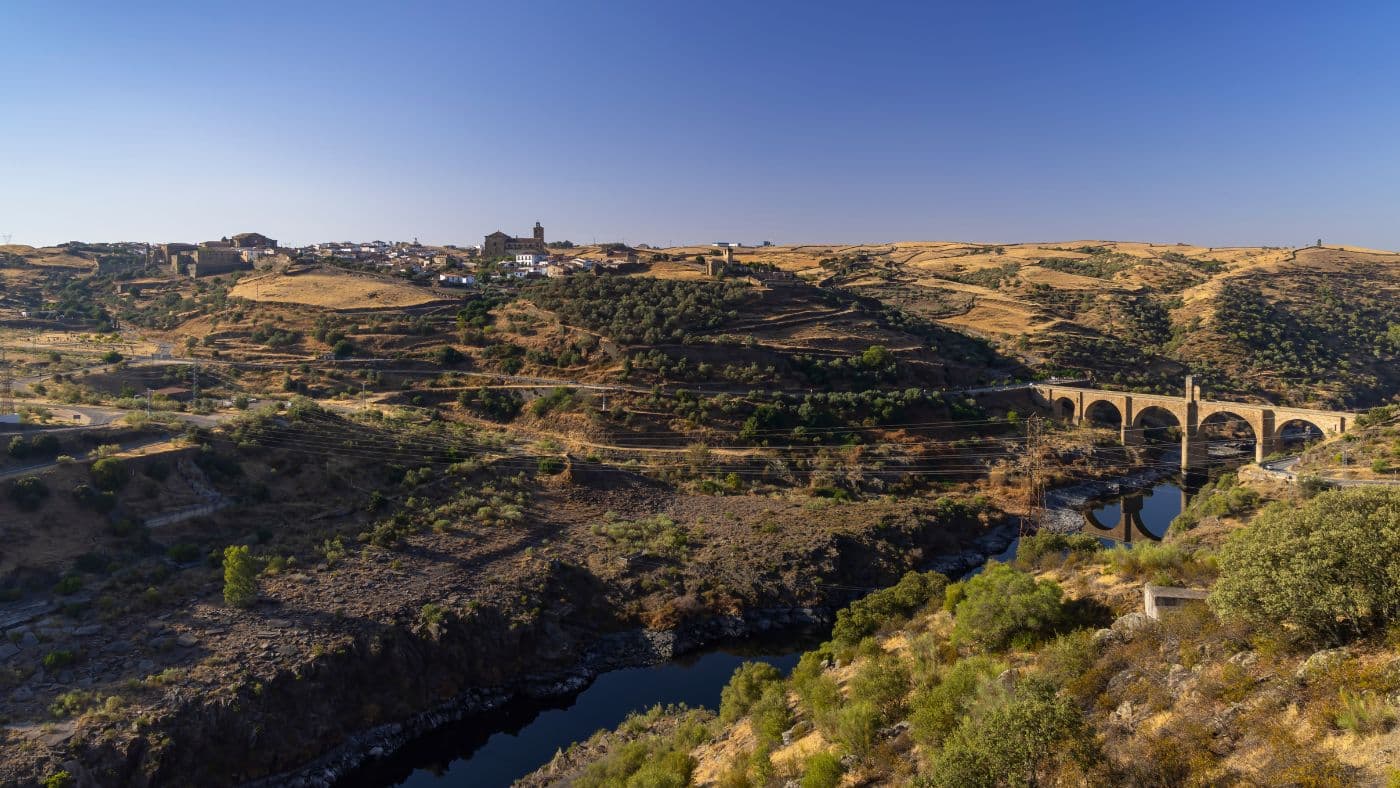
Extremadura's landscape is dominated by the dehesa, an ancient savannah of stone oaks and cork oaks that covers enormous stretches of the region in dappled shade. Wandering through it are black Iberian pigs, eating acorns with the focused dedication of animals who know their destiny is to become jamón ibérico de bellota, arguably the finest cured meat on the planet. The cork oak forests have been harvested for centuries without felling a single tree, since cork bark regenerates every nine years, making the dehesa one of the most sustainable farming landscapes in Europe. Extremadura produces more than a third of Spain's cork, along with paprika, tobacco, and cherries from the Jerte Valley, which turns a hallucinatory white every spring during the cherry blossom season.
Wild Spain at Its Most Rewarding
Monfragüe National Park, where the Tagus and Tietar rivers meet in a canyon of dark rock and ancient forest, is one of Europe's great birdwatching destinations. Black vultures and Spanish imperial eagles ride the thermals above the Salto del Gitano, a dramatic cliff where griffon vultures roost in numbers that have to be seen to be believed. The region's low population density, which can feel like a drawback in the abstract, becomes an asset in the field, making Extremadura one of the least crowded destinations in mainland Spain. Badajoz, the largest city, sits on the Portuguese border with a fortress complex that is genuinely the largest of its kind and era in Europe, and the evenings there have the easy, generous rhythm of a city that has never needed to impress anyone.
Official and Indigenous Names
- Extremadura (Spanish)
- Extremadura (English)
Region
- Iberia
Continent
- Europe
Resident population
1,054,681
2024 data
Capitals and seats of government
- Mérida
Currency
- Euro (EUR · €)
Driving side
- right side of the road
Electricity
Languages
Spanish
Official by law · ISO 639-3: spa
Spanish Sign Language
Official in practice · ISO 639-3: ssp
Extremaduran
Indigenous · ISO 639-3: ext
Fala
Indigenous · ISO 639-3: fax
Largest cities by resident population
- Badajoz · 150,702
2024 data
- Cáceres · 96,448
2024 data
- MéridaMJV · 59,894
2024 data
- Plasencia · 38,009
2025 data
- Don Benito · 34,544
2025 data
Busiest airport by total passengers
- Badajoz AirportBJZ · 80,254 annual passenger movements
2023 data